


PULSE Platform and Management Fusion Empower the Ukrainian Dance Scene in Romania
- Jul 6
- 2 min read
During June, the European cultural cooperation project dancEUA and the Ukrainian contemporary dance platform PULSE brought together a series of powerful performances in Sfântu Gheorghe (Sepsiszentgyörgy), Romania. The whole event drew 363 audiences, both local and international guests. Created in the shadow of war, these programs demonstrated how movement can articulate trauma and redefine identity, turning fragility into radical strength.
The Body as a Living Archive of Transformation
In the context of war, where physical archives are exposed to destruction, the dancer's body becomes a repository of truth. The production Cossachka (directed by Yuliia Lopata and choreographed by Gala Pekha) featured an independent female collective whose performance served as a strong bulwark against dehumanization. Similarly, Yaroslav Kainar’s solo performance, Annihilation, guided the audience through a process of transformation, suggesting that the destruction of the outside world forces a profound internal metamorphosis.


Cossachka; Photo by: Izsák Előd


Annihilation; Photo by: Izsák Előd
Exploring Loss and the Mythology of Violence
War imposes an absurd logic, a theme deeply explored in 2-1=4.5.0 by the Monada Dance Project. Directed by Krystyna Shyshkarova, the piece uses a title that acts both as a mathematical paradox and a Ukrainian military code for "everything is safe," diving into the intimate sphere of loss and how the absence of an individual permanently alters family structures. Meanwhile, Mariia Bakalo’s Maze without a Minotaur used ancient mythology to analyze systemic violence. By employing a participatory format, Bakalo erased the safe distance between the observer and the victim, pulling the audience into a labyrinth where the Minotaur is no longer a myth, but the tangible barbarism of modern warfare.


2-1=4.5.0; Photo by: Izsák Előd


Maze Without Minotaur, Photo by: Izsák Előd
Institutional Resistance Through "Management Fusion"
Cultural resistance is incomplete without sustainable infrastructure. so following the open call, ten artists participated in the Management Fusion program: Iva Matošević (Croatia), Sofija Milić (Croatia), Daniel Dragomir Alexandru (Romania), Georgios Pelagias (Sweden), Linus Jansner (Sweden), Daria Voznyakovska (Ukraine), Diana Hebre (Ukraine), Inna Matiushyna (Ukraine), Maryna Baranova (Ukraine), and Olena Khavroshyna (Ukraine). Namely, the Management Fusion program, part of the dancEUA project, redefines professional development as the logistics of survival.
Building on the success of the offline sessions, the program will continue in September with a series of online masterclasses focused on global production, eventually leading to job-shadowing practices across Europe that will equip participants with skills in sustainable funding and strategic management.

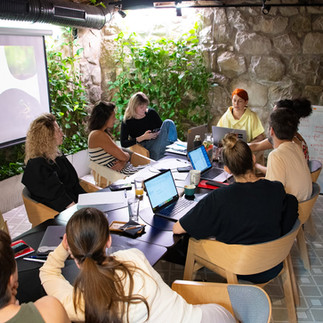


Management Fusion; Photo: Izsák Előd
Facing the Responsibility of the Observer
The concluding performance of the PULSE platform, Rubicon by Anthill Dance Theatre (choreographed by Inna Matiushyna), offered a sharp analysis of history's cyclical nature. Unlike other pieces focused on the trauma of the victim, Rubicon shifted the focus to the political responsibility of the observer, reminding the audience that passivity in the face of destruction is an active participation in the cycles of violence.


Rubicon; Photo: Izsák Előd
The three-year project dancEUA is co-funded by the European Union through the Creative Europe programme. It is implemented by Studio za suvremeni ples (Croatia), Central Europe Dance Theatre (Hungary), M Studio (Romania), Vitlycke – Centre for Performing Arts (Sweden), and Ukrainian Contemporary Dance Platform (Ukraine). Through residencies, educational programs, productions, and touring activities, the initiative fosters knowledge exchange, mobility, and sustainable partnerships between European and Ukrainian dance professionals.


Comments